
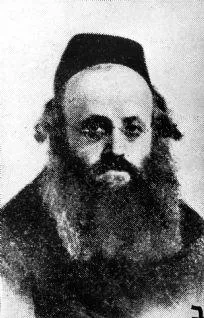
 By: Daniel Reiser
Rabbi Klonimos Kalman Shapira was born on Shabbat morning, Parashat Pinchas, 14 Tammuz 5779, July 13, 1889, to his father Rabbi Elimelech Shapira, the Rebbe of Grodzisk (1824-1892), and to his mother Rebbetzin Hanna Bracha Sternfeld (1862-1939), daughter of the Rebbe Rabbi Chaim Shmuel of Hanczyn. Before he was three years old, his father passed away, and at the age of fifteen he was taken under the guardianship of Rabbi Moshe Yerachmiel Hofstein, the Rebbe of Kuznitz (1860-1909). When the boy Klonimos was about sixteen, the Rebbe of Kuznitz also became his father-in-law after marrying him his daughter Rachel Chaya Miriam.
In 1913, at the age of twenty-four, he was appointed rabbi of the town of Piaseczno (Polish: Piaseczno, Yiddish: Piaseczna), near Warsaw. In 1917, after World War I, he moved to Warsaw and continued to visit Piaseczno for short periods. In 1923, he founded the Da’at Moshe yeshiva in Warsaw, named after his father-in-law, Rabbi Yerachmiel Moshe, which was the largest Hasidic yeshiva in Warsaw and had about three hundred students in the 1930s.
The Rebbe was a member of Agudat Israel, which in Poland was called ‘Agudat Shlomi Emoni Yisrael’. However, he belonged to the Land of Israel line of Agudat Israel and supported the establishment of Haredi settlements in the Land of Israel. Under the influence of his brother Rabbi Yeshaya Shapira, the ‘Pioneer Rebbe’, who was a member of the ‘Mizrahi’ movement and one of the founders of ‘Hapoel Hamizrahi’, bought land in the village of Ata, and was unwilling to sell it due to financial difficulties and his words of praise and greatness for the Land of Israel.
Piașca Hasidism is portrayed, according to contemporary press articles, as an ‘intelligent and modern’ scholarly Hasidism. The Rebbe himself conducted himself in a supra-political and supra-sectarian manner, which is reflected both in the diverse and diverse students he acquired over the years and in his good relations with Jews with views that were different and even distant from his own.
During his lifetime, the Rebbe published one book, Obligations of the Students, which was published in Warsaw in 1932. The book was supplemented by an educational article at its opening entitled ‘Dialogue with the Teachers and the Fathers of the Children’ and three articles in its appendix (‘How to Think in the Books of Hasidism’; ‘Torah, Prayer and Poetry 34’; ‘A Few Matters of the Holy Sabbath’). In addition, he published a booklet entitled ‘Children of Good Thought’ which was typed on a typewriter, duplicated in a number of individual issues and distributed to his select students. A collection of some of the Rebbe’s sermons on the weekly portions and the holidays given in the years 1925-1938 (1938-1939) was published under the title ‘The King’s Way’. His other books, ‘Hachasherat Havrechim’, ‘Mavo HaShari’im’, his personal diary ‘Tzo ve Ziru’, and the sermons he preached during the Holocaust were discovered in December 1950, among others, in a milk jug buried by members of the underground archive ‘Oneg Shabbat’ headed by Emanuel Ringelblum. The sermons from the Holocaust era were first published in 1960 under the title ‘Ash Kodesh’ and then in 2017 in a scholarly edition under the title ‘Deresh Mishnot Ha’zam’.
Even during the lifetime of the Rebbe of Piave, following the publication of his book The Obligation of the Students, the uniqueness of his educational teachings was recognized. Hillel Zeitlin called him in a review he wrote of this book – ‘Rebbe – Master Pedagogue’, and wrote that ‘one great thing our author innovated in the study of the aforementioned Hasidism. For he introduced order and method into it and opened an introduction to it from psychology and from theoretical and practical pedagogy.’ Psychological and pedagogical insights, with attention to modern reality and the adaptation of educational methods to changing situations, made the Rebbe a unique personality who was ahead of her time in the Hasidic world.
During World War II, the Rebbe stayed in his home at 5 Dzielna Street. On Yom Kippur 5751, October 12, 1940, the Germans announced the obligation for Jews to move to a certain area of the city of Warsaw, which they called the ‘Jewish Quarter,’ and on November 16, the ghetto was closed. The Rebbe’s home was in this area, so he did not have to leave and be uprooted. There, he apparently delivered his sermons and wrote his pamphlets, from the beginning of 1949, when the Germans invaded Poland and during the siege of the city of Warsaw, until Av 1942, the time of the ‘Great Aktion.’ His students say that he had several opportunities to leave the ghetto, but he refused, ‘declaring that it was unthinkable that he would save his life and leave his brothers to sigh.’ A newspaper article from 1940 reported that the American Joint Chiefs of Staff wanted to issue the Rebbe a visa to leave Poland, but he refused, saying: ‘I will not abandon my followers at such a difficult time.’ After the Warsaw Ghetto Uprising, in April 1943, the Rebbe was deported with the surviving Jews to the Trawniki concentration camp, near Lublin. The Rebbe was apparently murdered on the 5th of Cheshvan 5744 (November 3, 1943), along with the rest of the Jews in the camp, as part of Operation Erntefest conducted by the SS.